A theory of nuclear gravity. By Alan Folmsbee on February 12, 2026.
When I was in high school during 1967, the physics teacher said that it was not known why gravity has the weak value of G, based on any physical facts. What things in nature cause gravity to have the magnitude that it does? I propose the answer. Gravity is a volume effect. Space is a 3D volume. I expect proton and neutron volumes to be the sources of the small magnitude of the gravitational force. Space is treated as a liquid. Einstein, in 1915, did not know that neutrons or protons existed, so his theory of gravity copied G from Isaac Newton. Electrons have no known volume. Mass does not cause gravity. Gravity is caused by the volumes of neutrons and protons being withdrawn from outer space at the rate of a proton volume per 5ns.
Newton’s Universal Gravitational Constant G was calculated, relative to a proton volume. G = 6.6743 × 10⁻¹¹ meter3 kilogram−1 s−2.
G = V / (2 π m τ second)
where V is proton volume = (4/3) π r3, r is proton radius of 0.95fm (or any size you want, like 0.84fm), m is proton mass, τ is a time constant of 5.13ns when r is 0.95fm
The factors of G were found by using Gravity Volume Theory:
NV / τ = zA / (1 second) where N is the number of neutrons and protons in a star, z is the height fallen during a 1 second test of a falling apple, A is the surface area of a star, and 1 second is the duration of a test of a falling object.
That is the main formula for The Gravity Volume Theory of 2015 by Alan C. Folmsbee. NV / τ = zA / (1 second)
τ is calculated from that formula to be about 5 nanoseconds. That formula is named the momentum of free space. τ is calculated using any reasonable r, so it is not a universal constant, yet. V/τ is a universal constant.
Derivation of G, Newton’s Universal Gravitational Constant
Highlights of progressive changes to Newton’s Law of Gravity:
force = G M1 m2 / R2
where M1 is mass of a star and m2 is a small mass, like for a meteor or an electron
$$$$$$$$$$$$$$$$$$$$$$$$$$$$$$$$$$$$$$$$$$$$$$$$$$$$$$$$$$$$$$$$
1 Gravity is not caused by the mass of a star, so M1 is replaced by a causation factor about the volumes of protons plus neutrons and a time constant
2 Gravity of a star attracts a small mass m2
3 Use Newton’s formula and replace GM1 by NV/2πτ seconds
4 N is the number of neutrons and protons in a star, V is the proton volume, τ is 5.1ns
$$$$$$$$$$$$$$$$$$$$$$$$$$$$$$$$$$$$$$$$$$$$$$$$$$$$$$$$$$$$$$$$
m2 = np*m + nn*m + ne*me
where
np is the number of protons in the small object, nn is the number of neutrons in the small object, ne is the number of electrons in the small object, m is the mass of a proton or neutron, me is the mass of an electron, V is the volume of a proton or neutron. Electrons have about zero volume, so they cause about zero gravity. Mass is area, like a parachute in a lake. Accelerating the parachute with a rocket causes the inertial reaction that partially inhibits acceleration. The area of the parachute is like the magnitude of the mass. Volumes of water draining into nucleons cause the massive parachute area to move towards the drain. Space is like a liquid, flowing to move a mass. Time is emitted by the nucleon and when that time passes the parachute, acceleration occurs. That is gravitational acceleration. No rockets needed; just a liquid flow into a star and a time growth out of each proton and neutron makes acceleration of a distant mass.
V/τ is the causation factor associated with each proton mass. Set the two formulas equal, solve for G. Replace G M1 with N1V/(2 π τ seconds). Force is replaced by force units, so the units of measure in this replacement are valid.
force = G M1 m2 / R2 = (N1V/(2 τ π seconds)) m2 / R2
solve for G
G = ((N1V/(2 π τ seconds)) m2 / R2) / (M1 m2 / R2)
G = V / (2 π m τ second)
where M1 = N1 m and m is the neutron mass and N1 is the number of protons and neutrons in the star.
Where did the 2π come from?
G = V / (2 π m τ second)
A sphere has an area of 4 π r2 and a hemisphere area is 2 π r2.
2π in the G factorization is due to τ time being emitted by a hemisphere area of each neutron and proton. For gravity to affect a remote mass, only one hemisphere is facing the mass. Fig. 0 shows a proton causing gravity by consuming space and emitting time in an equal magnitude. Time goes at the speed c: the speed of time. Light moves at the speed of time.
The 2 π r2 area does not include r2 in the denominator because the numerator already has V. Time departs a proton so the factors divide the G. Space enters a proton (Fig. 0) so the r factors multiply the G. The 2 π is a scaling factor for time. Space was already scaled using V = (4/3) π r3 . Spacetime is detailed in this Gravity Volume Theory of 2015. During 1915, spacetime was described in general. The neutron is basically a proton, for gravity, and the general theory of relativity used G from Isaac Newton.
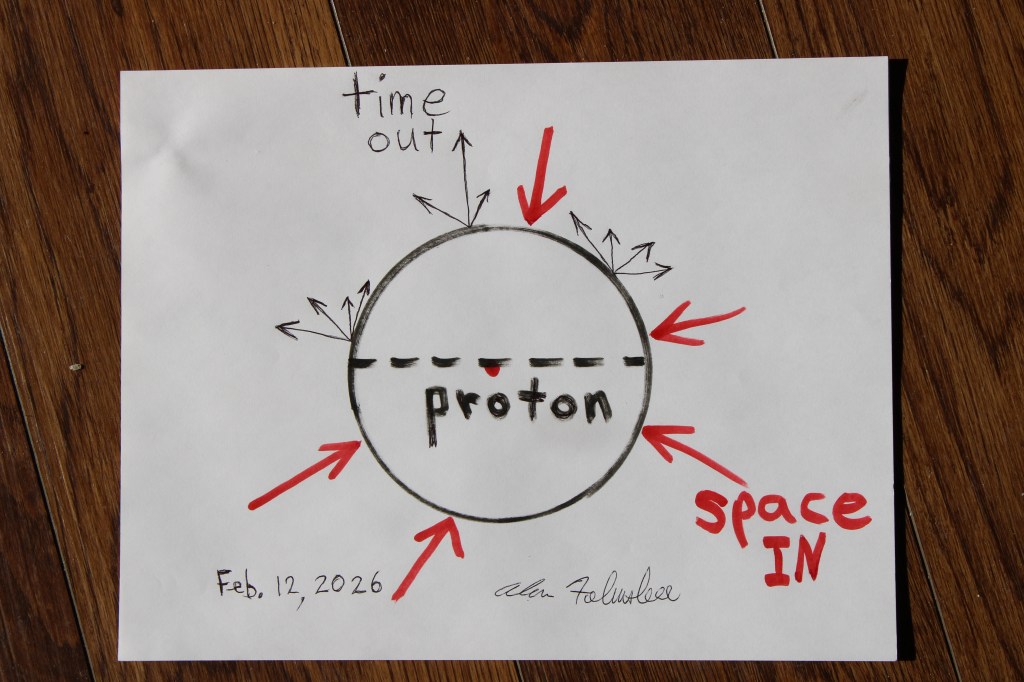
Figure 0: proton emits time from a hemisphere towards a remote mass
I tried to justify 2 π being in the denominator of the G factorization. (Under construction 2/11/2026). The reason is that it gets the right answer when 2 π is put in the denominator, even without justification. I expect that the factor is justified by one of two reasons. Maybe it is justified when the star mass is replaced by star volumes of nucleons. Or maybe it is justified because the 2 π is attached to τ. In Newton’s force formula, I replaced GM1 by NV/2πτseconds so the theoretical cause of gravity replaced a mass.
If 2πτ is justified in the G formula, why is the momentum of free space formula using τ instead of 2πτ? (Under construction 2/13/2026).
Momentum of free space NV / τ = zA / (1 second)
That is basic idea of The Gravity Volume Theory: the volumes of nucleons per 5ns equals the volume of the fallen shell per 1 second. Maybe that is needed to distinguish between acceleration and momentum.
Gravity Volume Theory without π
Momentum of Free Space Formula
Nr3 / 3τ = zR2 / (1 second)
Factors of Newton’s G
G = 2r3 / (3τm second)
where N is number of nucleons in a planet, r is proton radius, τ is about 5ns, z is height fallen in a 1 second test, R is the radius of a planet, 1 second is duration of test dropping an object, and m is proton mass.
Calculate τ for any proton radius, like 0.95fm or 0.84fm
τ = Nr3 second / 3z R2
Mass equals area theory
In my gravity volume theory, mass cannot cause gravity because mass is area. The mass equals area idea is proven by evaluating “electron mobility equals conductance, except magnitude”. That provided The Composite Formula:
Capacitance x Mass = second2 x meter2
Mutual gravity
The star’s gravity is a two-way effect with the small meteor. The meteor volumes cause the masses in the star to react, as an equal and opposite gravitational force:
Big star volumes of nucleons attract the small meteoric mass areas by force F.
The small meteoric volumes of nucleons attract the star’s big mass areas by the same force magnitude: -F.
Philosophy of gravity, Dec. 22, 2024
- Time grows
- Space shrinks into matter, like a liquid
- The curvature of space is the speed of space changing with position
- The curvature of time is only large near a nucleus, where time is denser
- The speed of time is c, as it is emitted by neutrons and protons
- Conservation of continuum: a proton emits 5ns of time at speed c as it consumes its volume from space
- Erbium laser fiber amplifier formula for quantum state from the 5ns gravitational time constant.
- The strength of gravity versus electricity
- The mirror in the center of each proton
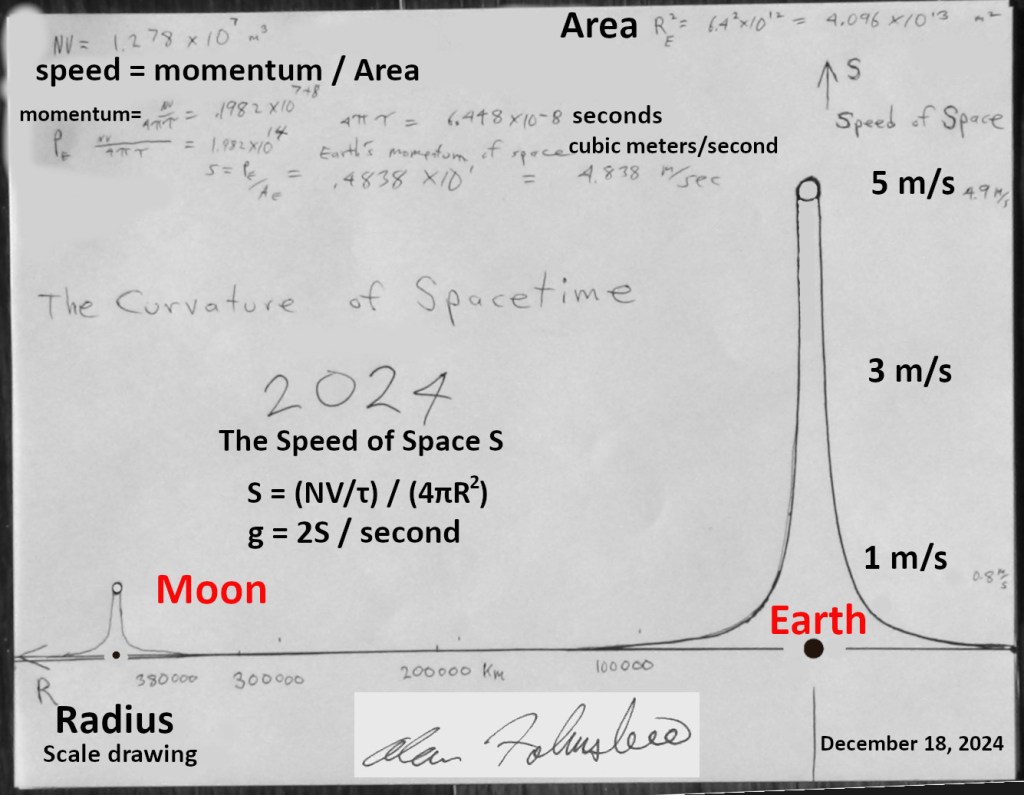
Figure 1: Spacetime curvature scale drawing for gravity, see paper on Abstract Units
The speed of space is S. N is the number of neutrons and protons in a star. V is proton volume. τ is a time constant of 5ns. R is distance to center of star from a test mass.
S = (NV/τ) / (4πR2)
This is compatible with relativity. Time has the opposite direction as the gravitational motion of a space, relative to a massive piece of matter. No other researcher has provided a scale drawing of space curvature. They use an elastic trampoline with a bowling ball to roughly imply that gravity makes the curved membrane. That recursive explanation is absurd because it needs gravity to illustrate gravity without precision. Certainly the trampoline is not a 1/R2 curve. Those fakers do not even write the units of measure of the vertical axis. The units are not even implied or hinted at.
Fig. 2 shows spacetime curvature, for time. The horizontal axis is R, the distance to the center of a carbon nucleus. The vertical axis the the time density W, which results in higher time derivatives being significant. The chain rule combines the variable time density with the varying speed of space near a nucleus. This can be a strong kind of gravity.

Figure 2: Time curvature scale drawing, as part of gravity in the carbon nucleus and outside. See paper #9 .
Fig. 2 shows the curvature of time. The vertical axis is 0 to 18 for W. That means the tenth derivative order is in dt/dR. For example d10t/dR10 is a factor used in a chain-rule formula. W=20 might be the highest practical order of derivative to be used to model a nucleus. The inner area of the cubic nucleus is about 5 times the area of the gaps in the outer faces of the cubic lattice for carbon. A second order gives acceleration, ∂2R / ∂t2 = a . 10 = 2 x 5. The time density is a function of R and the speed of space is a function of time and R. The strong nuclear force can be gravity. The gluon kludge can be obsoleted so no “glue particle” is needed to hold nucleons together in an atom. Quarks are obsolete and gluons are absurd. January 18, 2026 Alan C. Folmsbee MSEE.
Time is a figment of your gravitation
History of protons and gravity theories
- 200 years of protons and gravity theory
- Curvature of space
- The speed of space S
- The strong nuclear force may be gravity
- Time is emitted by several nucleons and it escapes the core through gaps
- Time is thickest as it exits the gaps between nucleons at speed c
Tsunami Gravity at the Speed of Light to Shoreline
Abstract
The wave is so big that it causes gravity to pull water away from shore. If a wave rises 10 meters in a second, 50 miles away, the shoreline waters will recede immediately (1 millisecond). The gravity from the remote wave is about 12 times weaker than the gravity from the Moon, so the shallow waters move away from the shore.
Introduction
A calculation of the wave gravity assumes a 10 meter wave height H. The volume of water V uses the wave length L and depth D
V = HLD
The earth’s curvature limits D to 50 miles.
Tsunami Gravity
I just made a calculation for a tsunami making the water recede before the wave hits land. The gravity from the remote bulging water wave has an attraction 12 times weaker than the Moon’s attraction of the tides! Tsunami wave attracts the water near shore, so the tide goes out 12 times weaker than the moon can pull the tides out from shore. But a bigger wave could be as strong as the moon.
Wave volume V = HLD
H = 10 meter wave height
L = 80km wave width along a beach
D = 80km wave distance, limited by curve of earth, away from a beach
r = 40km radius to center of wave
g = GM/r2 is the acceleration due to gravity, standard formula
M is mass of water in wave volume V
g = 0.0000027 meter/second squared for tsunami wave gravitational acceleration
g = 0.000034 meter/second squared for moon at beach
Inside a proton
- Mirror in the proton
- Mirror in electron
- Mass defect
- Quarks are obsolete
- G = Newton’s constant, relative to proton volume V and a 5ns constant
Nuclear gravity theory: during 2014, the Gravity Volume Theory was proposed. The strong nuclear force is gravity. This theory is compatible with general relativity, so time has the opposite sign from space dimensions.
Time grows. A scholarly reference is linked here from someone else.
Conservation of continuum connects time to space.
Space shrinks into matter to cause gravity.
Time grows out of matter for gravity to provide acceleration at a remote mass. A proton emits 5ns of time at speed c as it consumes its volume from space. Space drains into neutrons and protons at a constant rate. On Earth, the space flow rate is 16 feet per second. Time goes the other way from space.
History of proton’s size, versus dates of gravity theories is described later.
The idea of Mach that inertia is related to all the stars is considered.
Time grows out of protons and neutrons as space drains in. The conservation of the spacetime continuum is expected. Therefore a proton volume V is consumed by each proton in five nanoseconds. The following law will lead to a new type of momentum equality.
| 5ns | = | V |
The magnitude of about 5ns equals the magnitude of a proton volume. It is a law.
The relativistic “curvature of space” is the velocity of space (S). In high school, curves were introduced, for general variables. In this common high school sense, gravity has a curved space. The velocity varies with position, so a curve can describe S, the speed of space, relative to something. A nova star can change state when S approaches c.
Speed of Time is Speed of Light (c). Time is emitted by each proton or neutron, radially, at the speed c. Time is then involved with inertia and gravitational acceleration.
Space is treated as a liquid. See reference from other scientists.
The Chain Rule for second order derivatives near a nucleus is written. That can explain how the strong nuclear force could, plausibly, be gravity. Time emerges from inside surfaces in the nucleus and the gaps between nucleons constrains the time emission. Space flows into the nucleus through the gaps between nucleons (protons and neutrons). Time is denser as it passes through the gaps, and time has different densities at various places near a nucleus. The chain rule uses dt/dx for example to implement this algebraic-geometric idea. In other words, impact is expected to be a derivative of acceleration, as the chain rule provides high order phenomena. The derivative of impact could make the nuclear gravity even stronger. 3/9/24
The mirror in the center of each proton
There is an internal nuclear mirror from gravity to electricity and back. It is an 8 dimensional conveyor belt. Look into a mirror. You are looking inside some protons. Look at a feather and see the electrons and their discrete mirrors.
Discrete sources of continuous actions: quantum gravity essay plan.
Quark theory is obsolete. Essay plan.
__________________________________
A new momentum equality
NV / τ = zA / (1 second)
N is number of baryons in a star, V is proton volume, τ is about 5.1ns (tau), z is height fallen by a mass onto the surface in a second, A is surface area of star, 1 second is the time for a mass to fall in an experiment. This formula allows the 5 nanosecond gravitational constant τ to be calculated. Then, Newton’s constant G can be formulated relative to V, the proton volume. Since V is a value that has some uncertainty, the universal gravitational ratio of V/τ is published:
V/τ = 7.02 x 10-37 meters3 per second
That volume per second is the momentum of free space per proton or neutron. That linear momentum is used with the angular momentum of Planck’s constant to unify atomic theory with gravitational theory.
History of proton’s size, versus dates of gravity theories
- 1687 Newton’s gravity theory and G
- 1746 Benjamin Franklin wrote about a positive charge and a negative charge (proton and electron not named) Alessandro Volta (born February 18, 1745)
- 1815 William Prout theory of a proton
- 1831 M. Faraday
- 1886 H+ ion observed, hydrogen nucleus was seen with no electron associated
- 1915 General Theory of Relativity published using G from Newton
- 1917 proton was identified in another element by Rutherford
- 1932 neutron discovered by Chadwick
- 1955 proton charge radius measured as 1.45fm (Kenneth W. Ford)
- 1960s neutron radius is the Compton wavelength 1.3fm
- 2015 Gravity Volume Theory published using 0.95fm (Alan Folmsbee)
- 2024 proton charge radius 0.8414fm
The history list shows that proton and neutron volume information could not have influenced the General Theory of Relativity. Einstein believed that matter made gravity but he was not familiar with nuclear matter, as we are today. Einstein did not write that mass causes gravity. “The Meaning of Relativity” by A. Einstein says that gravity is made by material objects that have mass.
The idea of Mach, that inertia is related to all the stars, can be compatible with the idea that space is a liquid that stars consume. The potential space beyond the visible universe can be a reservoir that allows stars to drain space, to make gravity have a universal strength. The same liquid space acts to create the inertial force that an accelerating mass has. The idea that stars and black holes are depleting the liquid space could be tested and measured as a change in the inertial force. The depletion of space is accompanied by time that is not depleted.
The analogy of gravity’s four dimensions is made with electromagnetism. One dimension feeds from a proton to a neutron, commonly. The remaining time-like dimension and two space-like dimensions feed like a conveyor-belt from a proton to an electron and back. Mirrors are in the centers of those particles, in this theory. Not quarks.
For gravity, we stand on Earth and look up at the sky, which can be recorded in two dimensions. Space drains into the planet and time grows out, in two equal magnitudes.
For electromagnetism, we stand on an electron and look up at the proton, which can be recorded in one dimension. A time-like dimension drains into the electron from one paired proton and two space-like dimensions grows out of the electron and go to the proton. Time-like drains into the proton from one electron and two space-like dimensions grow out of the proton to go to the electron. That pair is called a flat sub-universe. It can expand, like the universe can expand. The electron-proton pair has direct interactions. Numerous pairs use induction to interact with other electron-proton pairs. The induction involved magnetic lines of flux, also called wavefunctions.
Mass equals area theory
Mass does not cause gravity. Einstein wrote that gravity is caused by objects that have mass. Matter causes gravity, not mass. Unfortunately, matter starts with m. Mass and matter both start with m, so confusion occurs about e=mc2. Matter has several properties, like temperature, mass, volume, chemical potential, thermal conductivity, and net charge. Mass is not what has volume that causes gravitational volume changes. Protons have that volume to cause gravity. This is the gravity volume theory, where space is treated as a liquid.
Matter has a volume of its nucleons, (protons and neutrons). The volume causes gravity, not the area. The areas of masses are affected by the speed of space S and the time that passes by the mass. Inertia is about the area of a mass being affected by the liquid space, like a parachute will resist acceleration in a liquid. Conversely, a mass is accelerated due to the local speed of space and availability of time flow.
Mass is used in chemistry for internal coordinates
According to my theory, mass is meter2. Standard physics does not agree.
1 kg = 1.21 square meters, because a proton is 20.4 barns in area.
The mass=area theory is mathematically supported using the mobility equals conductance theory. Then, the Composite Formula is provided:
mass X capacitance = meter^2 X second^2
that is on a website of mine, so search it for “composite formula”.
July 29, 2024
==========================
Erbium laser fiber amplifier formula for quantum state lifetime from gravity
The 5.12 nanosecond gravitational time constant tau is used with Planck’s constant h_bar
P = Z*h_bar / (tau squared)
P is Power to replenish an erbium quantum state = (2.51 eV per second)*Z
lifetime = E/P = 2 pi nu tau2 / Z
where E is photon energy in laser, P is Power to replenish state, nu is frequency of photon, tau is 5ns, and Z is atomic number of erbium. Planck’s constant gets cancelled out. (From my notebook #14 dated 10/21/2022). The quantum state lifetime was calculated to be 11.8ms for the population inversion of some states.
The Strength of Gravity Versus Electricity
Gravity is weak and magnets are stronger than gravity. My philosophy is written here.
Each proton is gravitationally attracted to every proton and neutron in the universe. Each proton makes gravity that attracts all masses in the universe. Gravity is weaker because three dimensions for a proton make force for all 1080 massive particles. Gravity is for long ranges but electricity is for shorter ranges. If electrons have no volume, electrons do not cause gravity. Electrons are affected by gravity without causing gravity because electrons have mass.
Electrically, one proton is directly attracted to one electron at a long distance, but that proton is repelled by that one electron at a short range. A proton has a two dimensional interaction with the electron when the relative motion makes a magnetic field. Induction is what makes one proton-electron pair interact with other pairs, using two space-like dimensions and one time-like dimension. The flux lines are curved and twisted so induction can make apparent attraction for many electrons to one proton. Electricity is stronger because only two dimensions make the force between only the two particles in a pair. The short range and small numbers of particles that are influenced lets the electrical strength be more concentrated than for gravity.
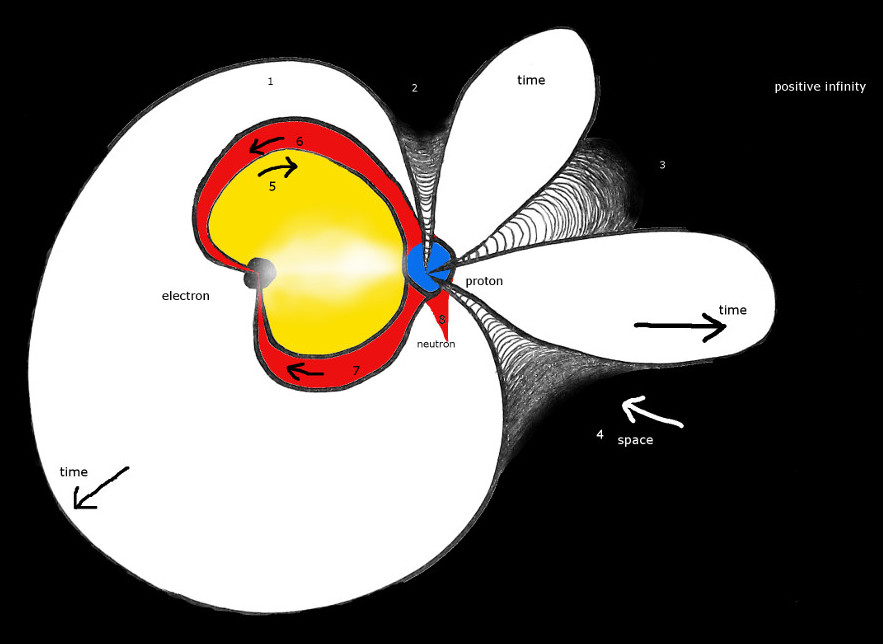
Figure: 4 dimensions of gravity and 4 mirror dimensions of magnetic-flux wavefunction-photon
Alan C. Folmsbee, June 6, 2025
 Nuclear Theory Data