There are three goals for the proposed company, The Durable Theory Company. This announcement is dated February 14, 2024 and October 11, 2025.
1 Sell a virtual reality program showing nuclei in chemical bonds and in magnets. Get the Blender files in this link. April 12, 2025.
2 Design a plasma fusion choreography antenna.
3 Artificial Intelligence can verify The Static Nucleus Theory of the Face-Armored Cubic Lattice, or describe its errors and degree of thoroughness.
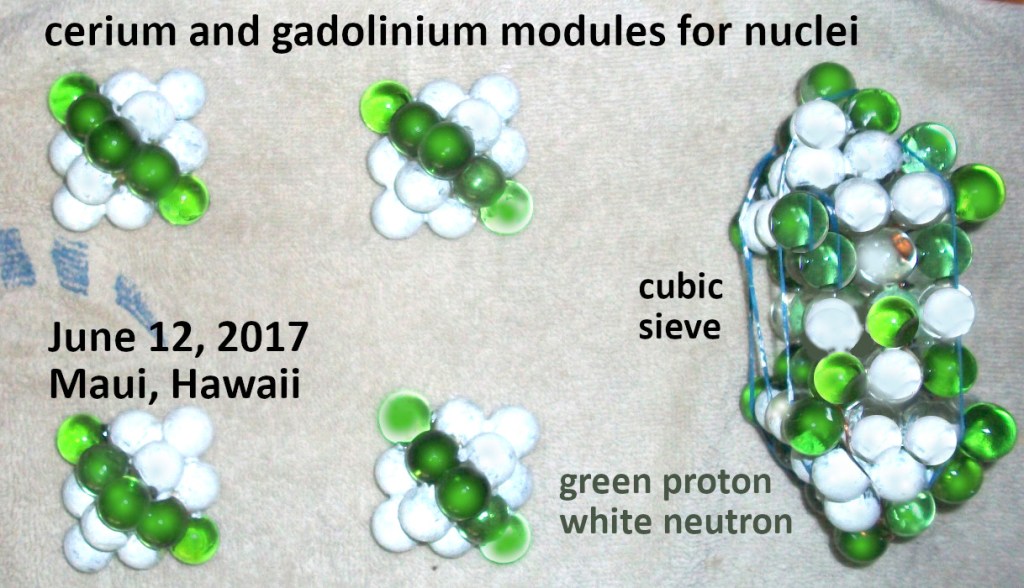
The hardware product, the antenna, will be modeled using the software product before experiments are started. Laypersons can use the software to explore a virtual reality model of several elements and scales, simultaneously. Starting in February, 2024, files for each element began to be offered. At first, the light chemical elements from hydrogen to nitrogen began being listed for free. The files include the xyz coordinates of protons and neutrons, jpeg images of models, and a Blender file 3D model for the nucleus. A 3D viewer is recommended on this website to rotate any nucleus. There will be 118 elements on this website of nuclear theoretical data. A Reversible Random Sieve Refrigerator Theory is proposed for gadolinium. The cube in the core of Gd has 14 protons that do not touch each other. Magnetic lines of flux crowd into that confluence zone. The animated software virtual reality views of the interiors of nuclei will show the external apparatus driving a vortex of flux to induce the nuclear e– p+ pairs to exit the sieve without a “re-connection-cycle of work”. The undulating shape of the proton ring gives some randomizing influence. Also, all adjacent pairs tend to induce a randomized motion for the core flux encounters. March 1, 2025.
Status: Feb. 14, 2024 links on nuclear-data.com are being organized. Chemical elements up to calcium have been inspected and approved for release this week.
Here is an example Blender file for sulfur: link
All 118 chemical elements have Blender files using this link.
The Blender version 4.02 was used. The protons are blue and the neutrons are yellow in my images. The .xyz format file uses a proton symbol Ar so it is blue and sized like a neutron. The neutron symbol was S to get the yellow color and diameter like the proton in Blender. The “import” menu item will accept the .xyz file for one element at a time, the way I am using it. The .xyz file data is given away in a different post. All 118 elements are in that one file, so you can copy one element from the file and paste it into a small file for one element. Name the file to know what to load in Blender. The text file for sulfur is here:
33
sulfur proton (Ar) neutron (S) February 1, 2024 acf
Ar -1 1 1 1
S 1 1 1 2
S -1 -1 1 3
S 1 -1 1 4
S -1 1 -1 5
S 1 1 -1 6
S -1 -1 -1 7
Ar 1 -1 -1 8
Ar -2.41 0 0 9
Ar 0 5.24 0 10
Ar 2.41 0 0 11
Ar 0 -4.41 0
Ar -1 3.82 -1
S 1 3.82 -1 14
S -1 3.82 1 15
Ar 1 3.82 1 16
Ar 0 0 2.41 17
Ar 0 0 -2.41
Ar 1 -3 1 19
S -1 -3 1 20
Ar -1 -3 -1 21
S 1 -3 -1 22
Ar -2 2.41 -2
S 0 2.41 -2 24
S 2 2.41 -2 25
S -2 2.41 0 26
Ar 0 2.41 0 27
S 2 2.41 0 28
S -2 2.41 2 29
S 0 2.41 2 30
Ar 2 2.41 2 31
S 2.41 -2 0 32
Ar -2.41 -2 0 33
That file sulfurF4.xyz has some comments added. The first line gives how many baryons are listed for this one nucleus. (protons and neutrons). The second line is a comment with an element name. The third line begins the 33 baryons: the first symbol is proton or neutron code, the second symbol is x, then y, then z coordinate. Anything after z is ignored as a comment.

Figure 1: Sulfur-33 nucleus using blue protons and yellow neutrons in Blender 4.02
This is the beginning of a virtual reality display of nuclear structures and fields. Imagine fantastic futures based on the goals that are now being written for Molecular Cosmology. That uses an analogy between electron-proton pairs and the universe of gravity. Here is a table with vectors for light elements. The vectors are the directions for bonds to be connected to the nucleus. The proton numbers are for each element in the file nuclei_118_M.xyz . The coordinates of the two protons listed are subtracted to give the vector direction.
Table 4: bond fulcrum directions for chemicals
Table 4: Bond fulcrum directions for elements’ nuclei
The bond angles can be calculated in molecules using this connection to each nucleus. There are also more tables in this link. To select which proton number is near the end of a line of protons, see my book, Charge distributions on the nuclei (2022) on Amazon. That book has 400 images of all elements’ nuclei, with numbered spheres.

Figure 2: choosing color codes and sizes of spheres to stack

Figure 3: protons-only: cobalt with green cubic lattice 9 and 19 on the axis, yellow ring of p+

Figure 4: Gadolinium using cube protons colored green, yellow proton ring, blue axis-related proton line. Notice that Gd has no cube protons in the rings and Co has all of the cube protons in the axis or rings. Therefore, the Co center has no protons and the Gd center has up to 14 protons like a screen to flux.
Artificial Intelligence can be modified to evaluate this Static Nucleus Theory. Old software (2024) gave poor artificial answers.
October 11, 2025
 Nuclear Theory Data
Leave a comment