In general, the goals will connect the nuclear data with chemistry, with magnetic technologies, and with nuclear phenomena. In chemistry, each nuclear proton will be modeled as being connected mechanistically to a molecular electron. Chemistry-related Table 1 and 2, 3 and Table 4 are near the bottom of this page. The electron-proton pair is connected with a line of flux. That is the quantum wave function. It has a 3D, not 4D, cosmology of two charges. A magnetic line of flux is a flat sub-universe.
Experiment to find memoglobin
A team is needed to use the paper #17 theory to plan an experiment to look inside nerve cells. I predict that iodine is at the center of a molecule that is similar to hemoglobin. One iodine atom in the center of the molecule has neutron spins that are used as memory. Pre-life organelles could start with that memory instead of needing DNA memory. Modern animal brains theoretically use the I-127 neutron spins for mental memories and for claw reflexes. December 7, 2025.
Research on July 5, 2025 is about Neutron Memory. See paper #14 “Brain Physics of Sleep and Memory”. The ferromagnetic elements near room temperature are Gd, Fe, Co and Ni. Magnetism is not the only amazing phenomenon from these materials. Elastocaloric nickel-titanium shape memory alloy is suspected to use neutron memory. My existing theory, on magnetic hysteresis in a cubic core of neutrons and protons, is being evaluated for mechanical and magnetic sharing of resources in the core of nickel (see paper 10 in that link). Electrons and the magnetic lines of flux from North and South poles are sequentially penetrating the core of the nickel or gadolinium nucleus (Fig. 2). A flux-spin-handshake occurs and a success begins training the neutron spin to be compatible with the two flux spins. After a long time, neutron spin memory exists from the training. The flux can be withdrawn from the cube and an electron passes through, but the neutrons retain the spin from the training. Electrons can enter the nucleus and exit the other side. Cold-rolling shares some phenomena with magnetic pole reversal, as a key training event. The memory metal effect is not magnetic but it uses ferromagnetic elements, maybe because the coaxial rings of protons focus the flux from the squeezing and expanding atoms. Lines of flux get inserted and extracted from the cubic core in the middle between the proton rings (Fig. 3). Possibly, neutron spins remember the hot flux shape needed for refrigeration, and the cold new flux is inserted into the core to be shaped by the neutrons’ memories of heat. The part of that line of flux, which is outside the core, therefore gets colder, to conserve proposed flux properties. Maybe that is wrong, and neutrons do not remember things for nitinol shape memory alloys.
Brain Neutron Memory speculation
The neutron memory capabilities for alloys of nickel could also be responsible for instincts and memories in animals. Iodine and zinc are example elements that are used in biological cells. Iodine deficiency makes “brain-fog”. The neutron spins could be inherited in DNA to communicate instincts to the next generations. Nitinol-style training, habits, histories, and memories are subjects that can be investigated for insects. The human hypocampus is a part of the brain for memories. Calcium neutrons might be used to reproduce instincts. Essential trace elements could be for memory. Substitute-elements in experiments could replace the expected memory cells with modified cells with no memory, due to missing access to the cubic lattice of the normal element. Maybe neutrons have no effect on neuron functions. 5/14/25
Alan Folmsbee MSEE

Figure 1: biologically necessary elements, iodine and boron. Electrons are not visible at the scale of the white protons and black neutrons. Electrons penetrate through the nuclear core in some cases and exit the other side of the nucleus.
DNA has some “useless” parts that may hold the neutron memories from past successful instincts from extinct species. For example, feeding is instinctive for various animals. Diffusion is not involved in neutron training. Nucleation and growth occurs for the neutron information to take effect on processes. To train a neutron spin, two electrons and lines of flux enter the nucleus like in a magnet, from two ends of the nucleus. A spin handshake is done until it succeeds. Then, time passes as the neutron reproduces the electron spin pair. Proton rings in iodine guide the flux into the core cube.
Valence
There are 4 tables at the end of this page. Table 1 attempts to map nuclear proton line end counts to valences for light elements up to yttrium. Tables 2 and 3 complete the first step of the “valence (V) comparison to proton end counts (N) for all practical chemical elements, up to americium. As a result of the tabulation of those integers for light elements in Table 1, it is observed that V varies from 0 to 6 and N varies from 0 to 8 !
Table 2 shows that for elements from zirconium to gold, V varies from 1 to 7 and N varies from 2 to 12 (technetium has N=12, but all stable elements in Table 2 have N < 7).
Table 3 shows that for elements from mercury to americium (element 95=Z) the valence V varies from 1 to 7 and N (count of ends of lines of protons) varies from 2 to 8. (Rings are counted into N, the number of ends of lines of protons for Table 3).
Table 4 has the Bond Fulcrum Vectors! Light elements from hydrogen to scandium are tabulated at the bottom of this page.
This answers an old question in chemistry:
Why are valences consistently 8 or less for elements with only 11 protons, and the same valence limit of 8 for chemical elements with up to 95 protons?
For example, bismuth has 83 protons but only 5 valence electrons. So, 78 electrons are non-bonding, which seems deserving of more explanation, in a theory. Algebra is the wrong tool. The lone-pair category needs an essay to describe those 78 unimportant electrons and protons.
Answer:
Protons make lines of protons. Heavy elements get longer lines, but each line only has two ends. A proton ring can be considered as having an end proton that protrudes the most. Valence electrons are associated with protons at ends of lines of protons. The protons in the middle of the line, but not at an end, do not make bonds with other atoms, unless the protons are protruding at a prominent location. The s-electrons are often associated with protons in the middle of a line of protons. The electrons associated with those “middle protons” bond with adjacent electrons, associated with an adjacent middle proton. Those are called lone-pair electrons. New theory by Alan C. Folmsbee December 1, 2024.
Academic Probationary Goals
Quarks and their particle zoo were placed on academic probation in 2023. The Nuclear Energy Advisory Committee for the USA Department of Energy was notified.
Magic numbers for nuclear isotopes are obviously absurd. Magic has been in disrepute for a century or two. Give those magic integers an articulate name. Try Numerology for Nuclear Science. See this 2025 paper on “Quantum Magic…” https://journals.aps.org/prc/accepted/eb078PecLee1430d67138ed74561b775faf651874
Magic angles for experimental techniques need an articulate name.
The Standard Model of Particle Physics needs an articulate name. Try “The Twentieth Century Guesses About What Might Be Inside Each Proton”. My theory is that a mirror is in each proton.
Photon theories are on probation. Photons do not cause gravity. They have no energy, only a velocity-like phenomenon from a fraction of a wavefunction. Velocity multiplied by the momentum of an atom is energy.
Mass Defect Theory
The meaning of “mass defect” can be evaluated using a three-dimensional model of a nucleus. The “mass equals area theory” is used to show that “shadowing effect” can explain the mass defect from fusion (Fig. 1). The ideas are modeling space as a fluid that has been called the aether, the spacetime continuum, the Higgs field, ether, and herenowium. November 24, 2024.
After a nuclear fission or fusion, a missing mass is also called a mass defect. That mass can be estimated from energy considerations or measured by averaging millions of measurements. Historically, single atoms are not tracked from uranium into fragments like cobalt and another fragment. As far as I know, the three masses are not recorded before and after a fission event, to a precision that reveals the instantaneous mass defects of the two fragments. The modern science here is about average mass defect. As each nucleus rotates, the shadowing varies.
The mass equals area theory can be proven by realizing that electron mobility has the same units of measure as conductance, with the distinction being the two magnitudes.
“Conductance is how easily an electrical current can flow through a conductor.”
“Mobility is the ease with which any particular type of charged particle moves through a solid material.“
See https://www.electrical4u.com/conductance and https://www.vedantu.com/physics/mobility to read those quotes. This evaluation shows that a Coulomb is an area. After you agree with “mobility has the same units as conductance, except size” then a simple calculation in algebra gives “The Composite Formula”. This formula surmounts the problem with isolating mass on one side of an equation to see a definition. Instead, mass with capacitance multiplied is advantageous for finding a definition of mass. Alternatively, a ratio of mass/capacitance could also be tried. Here is the definition of mass times capacitance:
kilogram*Farad = square meters times seconds squared
That evaluation showed (on the linked website) that a Coulomb is an area. If that is assumed on this summary, then the following calculation shows that mass is an area of spacetime.
mass*Capacitance = meter2 x second2
Example abstract units of measure
Energy = 1/2 CV2
C is capacitance (Farad), V is voltage, Q is Coulomb, kg is mass
kg meter2/ sec2 = Farad kg2 meter4 / Q2 sec4
meter2/ sec2 = Farad kg meter4 / Q2 sec4
Q2 meter-2 sec2 = Farad kg
meter2 sec2 = Farad kg

Figure 1: The Missing Mass is an area of spacetime.
1 kilogram = 1.21 square meters (Nov. 21, 2024)
proton mass = 20.4 barns
Mass Anomaly Paper
“High-precision mass measurement of 103-Sn restores smoothness of the mass surface”
C. M. Ireland, F. M. Maier, G. Bollen, S. E. Campbell, X. Chen, H. Erington, N. D. Gamage, M. J. Gutiérrez, C. Izzo et al.
Phys. Rev. C 111, 014314 – Published 9 January, 2025
https://journals.aps.org/prc/abstract/10.1103/PhysRevC.111.014314
Quote from paper: ‘In AME2020, this indirectly measured 103Sn mass was classified as a “seriously irregular mass” and replaced with an extrapolated value’
Nuclear Fusion Notes
Fusion reactors can benefit from knowing the shapes of nuclei and how the plasma induction is due to the pairing of each proton and an electron. That idea should almost duplicate older formulas, but based on a finer level of details of the “field theory”. Uranium fission is partially explained by the static nucleus theory (see bottom Figure). The goals for fission are educational goals. The goals for fusion are more useful.
A software product, “Bond Animator” has many proposed options. It will show far more than chemical bonds in a molecule. It also show tiny nuclear strong force fields. It will show big magnets in a primary and secondary loop in a transformer or plasma. It will show how iron is fused in a star to obtain two coaxial rings of protons. Electron-guided fusion will be visualized. The differential fusion of oxygen with nitrogen could allow a new understanding of tunneling to open the twisted pathway to a new energy source. Oxygen has its protons arranged in a double helix. Nitrogen has its protons arranged as a three pointed star. Those two shapes are so different from each other that separate driving techniques can cause non-random impacts.
List of mechanistic and deterministic views of molecules
1 Show the nucleus of each element at magnification of 10 trillion x
2 Line of flux from proton to electron, 2 space, 1 time dimension from an electron to a proton and back. The flat subuniverse with a local coordinate system. Viewed with straight-line view or universal view with twists and bends.
3 Line of magnetic flux as a conveyor belt contra-spline. The line induces effects in other pairs.
4 Atomic wave-function as a conveyor belt contra-spline. The “Cosmology of the Solid State” (reference wanted for that author)
5 electron gyration clockwise in magnetic field B, revealing why
6 ion gyration counter-clockwise in magnetic field B
7 covalent bond
8 ionic bond
9 van der Waals interaction attraction
10 valence electrons versus core electrons
11 strong nuclear force as gravity with dense-time chain rule
12 photon emission and absorption
13 electron guided fusion
14 magnetic induction from a primary current to a secondary
15 voltage as net density of charged particles
16 ohm as average Hertz per atom
17 Ampere versus Weber units of measure, display in space
18 radio versus photons: maybe not the same (3D vs. 2D)
19 platinum catalyst hook mechanism and itinerant proton current
20 iron flux vortex
21 neodymium flux driven by iron flux vortex in boron cages
22 zoom from femtometers to light years
23 plasma simulation for oxygen-nitrogen fuel
24 Universe mirrored with 4D sub-universes of atoms
25 Ambiguity of nuclear shape choices, notes
26 Confidence levels for various theories, noted
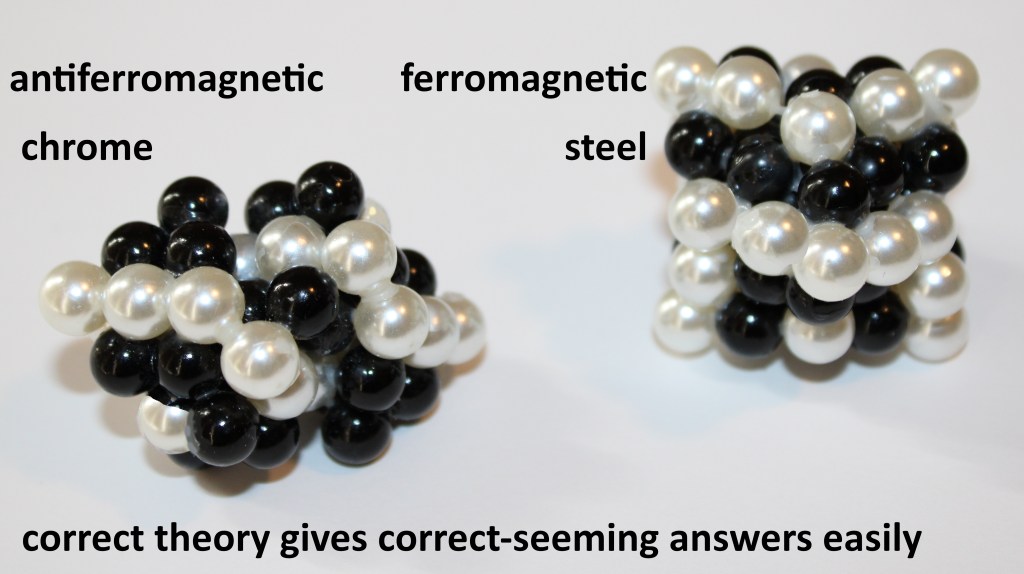
Figure June 5, 2025 from theory of May 25, 2017 in Maui, Hawaii
Experiments Wanted
1 Do photons cause some gravity? In my theory, no. Photons are affected by gravity. But the old science writes that photons have energy and energy causes some gravity, without matter. My idea is that gravity is caused by the volumes of protons and neutrons. Mass does not cause gravity and Einstein never claimed that mass causes gravity. Albert wrote that gravity is caused by material objects that have mass. See his book: “The Meaning of Relativity”.
2 Quantum of Gravitational Power Experiments, past and future. The Universal Constant 2.51eV per second is h_bar / ((5.13ns)2) can be used for many elements, not just in erbium laser fiber amplifiers. There must be old data that can be checked for quantum state lifetimes. The erbium laser fiber amplifier formula for quantum state lifetime from gravity is here:
The 5.12 nanosecond gravitational time constant tau is used with Planck’s constant h_bar
P = Z*h_bar / (tau squared)
P is Power to replenish an erbium quantum state = (2.51 eV per second)*Z
lifetime = E/P = 2 pi nu tau2 / Z
where E is photon energy in laser, P is Power to replenish state, nu is frequency of photon, tau is 5ns, and Z is atomic number of erbium. Planck’s constant gets cancelled out. (From my notebook #14 dated 10/21/2022). The quantum state lifetime was calculated to be 11.8ms for the population inversion of some states.
Alan C. Folmsbee, October 24, 2024
Pseudo-monopole experiment: magnesium has one ring of 12 protons. Iron has two rings of 12 that, in theory, make two pseudo-monopoles. I expect Mg cannot do that because one ring needs to do the spin handshake with 12 other lines of flux. But it could be contrived. See Highlights page for more detail of ferromagnetic theory.
“Pair theory” and test
My theory promotes a functional abstraction. Each proton is paired with one electron. That loyalty can changed when a different electron becomes loyal to the first proton, while the first electron becomes loyal to a second proton. An iron ring of 12 protons carries a superconducting current called “the loyalty current”. Pairs interact with other pairs using induction. Within each pair, direct interactions occur between an electron and one proton. The wavefunction is a flat membrane with laminar positioning with adjacent wavefunctions. They are also called magnetic lines of flux. The flux has a unit of measure, the square root of energy. Flux is meter squared per second, like a Weber or an Ampere. Electron mobility equals conductance units of measure, except for the magnitude.
Antimatter theory and test of “pair theory”
Each positron is paired with another anti-particle, the anti-proton.
But only the positron was measured, while the anti-proton was lost in the distance. Find paired particles.
Gravity theory and test
Gravity is created by objects that have mass, temperature, and volume. Mass does not cause gravity. Mass is an area in space. For all practical purposes, gravity is caused by the volumes of protons and neutrons.
Magnetic property theory and test
Spins of an electron eddy current on the South pole for a bar magnet has the opposite spin as electrons on the North pole. That is because the source of ferromagnetism is the pair of proton currents in a nucleus of an element that has a certain shape. The theoretical proton currents are mechanistically connected to the electron motions and spins. Measure spin up or down.
Magnesium-Iron Magnet
Mg has a ring of 12 protons. Fe has two rings of 12 protons. The cubic Fe is not easy to alloy with hexagonal close-pack Mg material. Few products are mentioned in literature. Cobalt-Magnesium https://www.americanelements.com/magnesium-nickel-cobalt-alloy-sputtering-target
Mathematician Wanted
0 Dimensions are defined using the primitive analogy of gravity and atoms. Gravity and inertia use 4 dimensions. Atoms with wave functions use 4 similar dimensions. Time goes the opposite way as space, for gravity. In an atom, a time-like dimension goes the opposite way as a space-like atomic local coordinate. A mathematician can add to the Theory of Enough or she can make corrections to the minimal set of dimensions. Eight dimensions are expected, but other researchers used ten dimensions.
1 My geometric sculptures and sketches of the iron nucleus with handshaking lines of flux are hard to express with algebra. Please join my team. See paper 10.
2 The strong nuclear force may be gravity, using the chain rule for the fourth order. Dense time near nuclear gaps makes the force stronger.
List of Topics I Want to Write About
1 Temporary loyalty of an electron to one proton. In an atom, obviously. In a plasma in a star, yes, there is always temporary loyalty.
2 In Mossbauer spectrography, iron makes a characteristic “sextet” of velocities. Propose that that is because a cube has six faces. Red shift and blue shift can be calculated for a proton ring current.
3 Quantum science uses S for the spin of an electron. My essay will describe that “lumped non-functional magnet” which is dimensionless for units of measure. S is usually multiplied by things to get energy. Things like “Planck’s constant squared, and divided by masses and differential lengths”. S is not articulated well in old science. S is a half of some integers (1/2 or 5/2).
4 The Strength of Gravity versus Charge
4D versus 3D analogy
All baryons versus one pair
Volume gravity versus membrane charge
Invention Titles
Flux Amplifier for H-field Normalized Velocity Using GdCr Cogs
Digital Memory from Memory Metal Nuclear Spin-Handshake Code in Gd. The audio readout uses the Barkhausen Effect to retrieve the memory bits, one at a time from the cube in the nucleus. Each Gd atom stores a sequence of 18 bits. NiTi alloys also can be tried for the discrete angle-information bits.

Figure 2: gadolinium nucleus showing only protons. The proton rings are seen on the axial view. The sieve of protons in the cube are visible on the left. Those protons are removed for the right picture. Coercivity is related to the green cubic net of protons that imposes constraints during elastocaloric and magnetocaloric experiments.
The cube in Gd is 3x3x3 with 14 protons and 13 neutrons. Those cube protons do not touch each other. Outside the cube, protons make lines of protons, commonly. In the sieve action during hysteresis experiment cycles of north magnetization and and then south magnetization, 36 flux lines in the sieve do the spin-handshakes. Fig. 2 has a proton ring around the perimeter, from this view angle. Each ring has 18 protons. In the center are three axial protons. one has a cross, one behind that is a sub-surface green cube proton, and the third is to the left of the center cross. Iron has axial protons and neodymium does not, on the surface.

Figure 3: simplified iron nucleus with 24 lines of flux after magnetization
The south pole comes from the proton ring that is on the north end of the nucleus, so crossing of all lines of flux has occurred. At the confluence of 24 lines, spin-handshaking proves whether two lines will slide or start to bond. Any bond action fails in the small zone of confluence in a tiny volume. Then, more handshakes are negotiated. Half-way situations can freeze the results in an unresolved truce. A cooling-off period can be employed, with no loss of informational entropy. Later extraction of the flux information inspires refrigeration. The nucleus is like a bank with deposits at one pole affecting withdrawals from the opposite magnetic pole. Pushing and pulling flux is the game, whether it is mechanically explained or if it uses magnetic induction.
Examples of the Precision this Theory Provides
Molecules can include the nuclear proton line geometries to drive torque in bonds. Ferromagnetic phenomena are known theoretically to be based on nuclear structures. That gives theoretical support to certain nano-technological experiments. For example, the picosecond light pulse experiment can reverse the magnetic poles in a thin film of a gadolinium-iron alloy. The link goes to a paper I wrote about Small Integers in Magnetic Material Facts and femtosecond light flashes onto a thin film.
Fission and a theory of a static nucleus

Figure 2: Bimodal mass distribution of fission fragments
Figure 2 shows the uranium fission fragment trend. One end of the U-235 nucleus is big and armored, while the other end is smaller and more fragile. Two fragments result with a heavy fragment and a light fragment mass. The theory shows the integers that match the experimental integers. A goal is to also evaluate plutonium and thorium this way.

Figure 3: Models of atoms (electrons not visible at this magnification) white protons and black neutron beads
Proton Line End Count
Chemistry can benefit by mapping oxidation states for elements into the count of the ends of proton lines. The negative oxidation states and positive ones are similar to the integers for valences.
The lines of protons occur in sculptures (Fig. 3) of most chemical elements because the Rules are followed. The Rules were written with using an insight for random lumped collections of 31 neutrons and 26 protons. For that iron model, it is required that protons touch protons. There are not enough neutrons to isolate all of the protons. Protons must always touch protons when mock-ups were tested for an almost-spherical candidate nucleus. It is unavoidable. Since two protons can touch, so can three. Inductive reasoning lead to shapes for all elements. Surprisingly, almost all elements have a number of line ends less than 8, just like valence!
The Microsoft Excel spreadsheet image, Table 1 rev. 60, has a vertical column highlighted in green for the valence value for each element from hydrogen to yttrium. Yellow highlights separate the 19 foundation elements and their incremental elements that are based on the foundations. A foundation element is defined as an element with a cube in the nucleus and six pyramids that armor the six faces of the cube. Incremental elements add neutrons and protons on the exterior of a foundation shape. Three spreadsheets are being made. First, elements from hydrogen to yttrium are tabulated. Then one table for chemical elements from zirconium to gold will be placed here. Third, Table 3 from mercury to americium was put on this webpage for goals. The spreadsheet tables are given in the .pdf format.
Table 1 Hydrogen…Y
Valence from Proton Line End Count
Table 1 for Hydrogen to Yttrium with atomic numbers Z from 1 to 39.
Table 1 has columns that are described next:
Left column 1: Z atomic number 1 to 39 hydrogen to yttrium, Z is the number of protons in the nucleus
Column 2: Element name of one chemical per row
Column 3: chemical valence from a reference book for many elements. Valence is an integer from 0 to 8 in high school chemistry. A goal is to calculate the valence as a function of the ends, the solo protons, and the rings of protons. Oxidation numbers are listed separately for negative and positive integers less than 9.
Column 4: Ends of Lines. Each line of protons has 2 ends. Some elements have no ends, like hydrogen.
Column 5: Solo protons. Count of lone protons that do not touch another proton. They have no “ends”.
Column 6: Rings of protons. One ring or two rings are common for elements. Zero rings appear for some elements’ nuclei. The most prominent protons are often on a ring. They can be subtracted or added with “ends” to attempt to get near an oxidation number.
Column 7: Nucleus type. There are 19 foundation elements as one type. They have a cube and six pyramids. Another type is the incremental element. It is like a foundation with added nucleons on the surface.
Column 8: Mass number A is the number of protons plus the number of neutrons for each element, using a common isotope.
Column 9: Oxidation state 1. Chemical information may relate to nuclear shapes
Column 10: Oxidation state 2. I am an electrical engineer.
Column 11: Oxidation state 3. To be continued.
Column 12: Oxidation state 4
Column 13: Oxidation state 5
Column 14: Oxidation state 6
Column 15: Oxidation state 7, chem. integer that might be the sum of nuclear integers
Column 16: Oxidation state 8
Column 16: Oxidation state 9, for future analysis, subtracting solo and adding a ring tip
Column 17: note 1
Column 18: atomic number
Column 19: Line 1 Length, the number of protons in a line listed in “ends of lines”
Column 20: Line 2 Length, for line mentioned in column 4 for line ends
Column 21: Line 3 Length
Column 22: Line 4 Length
Column 23: Number of protons in a ring
Table 2 zirconium…
Table 2 is ready for Zr to Au with Z from 40 to 79 (rev. 72 on Nov. 221, 2024). Abbreviations: 2shorted means two rings of protons are connected by a proton. trident222 means a 3-way Y shape of protons has each branch with a length of 2 protons (nitrogen only). Isoaxial means that the pyramids along all 3 axes (xyz) have equal sizes. bendo means the bend in a line of protons points “out” from the nucleus. bendi means the bend in a line of protons points “in” to the nucleus. cube2 means this element has a 2-layer cubic stacking of protons and neutrons. cube3 means this element has a 3-layer cubic stacking of protons and neutrons. cube4 means this element has a 4-layer cubic stacking of protons and neutrons (64 nucleons). 2 tristar is for only promethium and rings are joined with triangle-loops of protons. sparse2 means a set of lone protons line up but do not touch each other.
Maybe the valence is the count of line ends plus rings, like cobalt and ruthenium.
Table 2 for Zr to Au: Correction Tc technetium “Ends of Lines” is 12, not 10. (May 22, 2025)
Table 3 mercury… americium
Table 3 is for Hg to Am with Z from 80 to 95, rev. 60.
The Tables 1, 2, 3 provide clues about chemistry to help chemists make progress.
Table 4 Bond Fulcrum Vectors hydrogen to scandium
Table 4 is here. It has nuclear bond fulcrum vectors for elements up to scandium.
Column descriptions for Table 4
Left column 1: Z is the atomic number, count of protons in this chemical element
column 2: element name
column 3: Ends of Lines. The count of how many proton line ends exist on this nucleus. It is two ends for each line of protons. Rings are not included. The most prominent ring protons can make bonds, like a line end. There are solo protons that are not counted. But negative charges are possible to add to end counts, as an option, to attempt to approach the valence or oxidation state integers by a formula.
column 4: Line AB means proton A has a number taken from the xyz coordinate file “nuclei_118_M.txt” . For example, helium has 4 neutrons and protons that are on successive rows in the coordinate file. Assign 1, 2, 3, 4 as the proton number or neutron number. Column 4 is 1, 2 for helium. Subtract the coordinate of proton 1 from the xyz coordinate of proton 2 to find column 8, the A-B vector called vector 1. ( the file does not have the proton numbers, you make it up for each element yourself from the coordinate file “nuclei_118_M.txt“. That is “the file”.
column 5: lithium has 2, 3 for this column, proton 2 coordinates in “the file” are noted with proton 3. Two points define a Line.
column 6: carbon has 1, 9 in this column. That means protons 1 and 9 from “the file” coordinates will be used in a calculation. “the file” does not have numbers for carbon nucleons, you assume the xyz file format is sensible, or read the documentation. proton 1 is on the first line after the line marked: carbon.
column 7: carbon has 1, 10 in this column. That means protons 1 and 10 from “the file”
column 8: vector 1 is from subtracting the xyz coordinate of one proton from the coordinate of an adjacent proton.
column 9: vector 2 is from subtracting the xyz coordinate of one proton from the coordinate of an adjacent proton. For carbon column 9 has (-1.41, -1, -1). That subtraction of two positions defines a vector from proton 8 to proton 11 (see column 5). A chemical bond theoretically emanates from that vector direction. Bond enthalpy might be related to how many protons are in the line.
column 10: vector 3 is from subtracting the xyz coordinate of one proton from the coordinate of an adjacent proton. (see column 6 to finds which two nucleons).
column 11: vector 4 is from subtracting the xyz coordinate of one proton from the coordinate of an adjacent proton. (see column 7 to finds which two nucleons).
The Table 4 coordinates like 1.41 really are precisely the square root of 2. Elements are grouped in rows, starting with a Foundation Element, like argon. The group then includes the Incremental Elements that are made using the foundation, plus more surface nucleons. None of these chemical elements has a cube with 3 layers, in Table 4. The cube with 2 layers serves all elements from C to Sc. The cube in the core ensures two facts: two core protons correspond to two core electrons, and secondly, the surfaces of the nuclei grow the hexagonal close-pack organization. April 13, 2025.
Oxidation State Integers
The foundation elements are listed with the incremental elements that are based on each foundation. Differences of elements might be attributed to each series of foundation plus the associated incremental elements. Macroscopic functions and shapes emerge from the nuclei. The nucleus is not just isolated particles lumped near each other. When protons touch protons a line can form. A ring can form, or a hook-shaped line of protons. Magnetic functions can be made. Dynamic currents in lines can have a nuclear magnetic resonance. Steady currents in rings can have the nuclear magnetic stasis. The goal is to make the connections from nuclear protons to molecular electrons. The wave functions and lines of flux can be an angstrom or a meter long. The valences of elements might be determined by nuclear proton locations. A goal is to prove this theory to be far from correct or to prove that it seems to be almost correct.
A question occurs in chemistry about why oxidation states are limited to a number from about -8 to +8, even for an element with 92 protons. The Tables of Line Ends give the answer. Protons make long lines of protons with only two ends. If the line ends are forming bonds and the mid-line protons do not, then the small valence numbers and oxidation numbers are reasonable.
The Tables use the common oxidation state integers. But uncommon oxidation states can be visible in the “proton line end count”. An attempt will be made to map bond types to the proton position in a line. For example, one bond type can be in a middle proton in a line of protons. Another bond type can be for a core proton (lone pair). Another bond type can be for a proton on the end of a line of protons.
The Tables have the “lengths of proton lines”. Maybe atoms have a relation to those nuclear lengths, like long lines map to strong bonds. Maybe a bond length maps onto the proton line length. Rules in chemistry often have an exception. Maybe the proton position information will explain an exception to a standard rule of chemistry education.
Magnetic Flux Accelerator Apparatus
A gadolinium and chromium thin film device is proposed. The Gd has 18 protons in each ring but Cr has 10. A top layer of Gd is exposed to an external magnetizing field. The Cr is near the Gd vortex so the Cr is driven by the Gd. Cr has two rings: one will be hit with the Gd input flux and the other ring in Cr will be hit with the flux from the first ring. The resulting local H field of the second Cr ring is 1.8 times as high as the H field of the Gd vortex.
In future nanotechnology, boolean logic gates might be made from atoms like chromium. It is standard practice for digital logic gates that amplification occurs at each logic stage. The flux accelerator idea is intended for that purpose and the modest gain of 1.8 may be good enough for an atomic computer made with a thin film of Cr under a thin film of Gd. Flashes of light could be the clock for the boolean logic gates.
Charge distributions on the nuclei, 535 page hardcover by Alan C. Folmsbee (2022)
https://www.amazon.com/Charge-distributions-nuclei-Charles-Folmsbee/dp/B0BMDMHVFX
February 19, 2025
 Nuclear Theory Data